
The email tells you everything. A customer, politely confused, asking why they never received the invoice they paid for. You check, and they are right. The automation that was supposed to send it failed four days ago, and this is the first anyone heard of it. Not from a dashboard. From the customer.
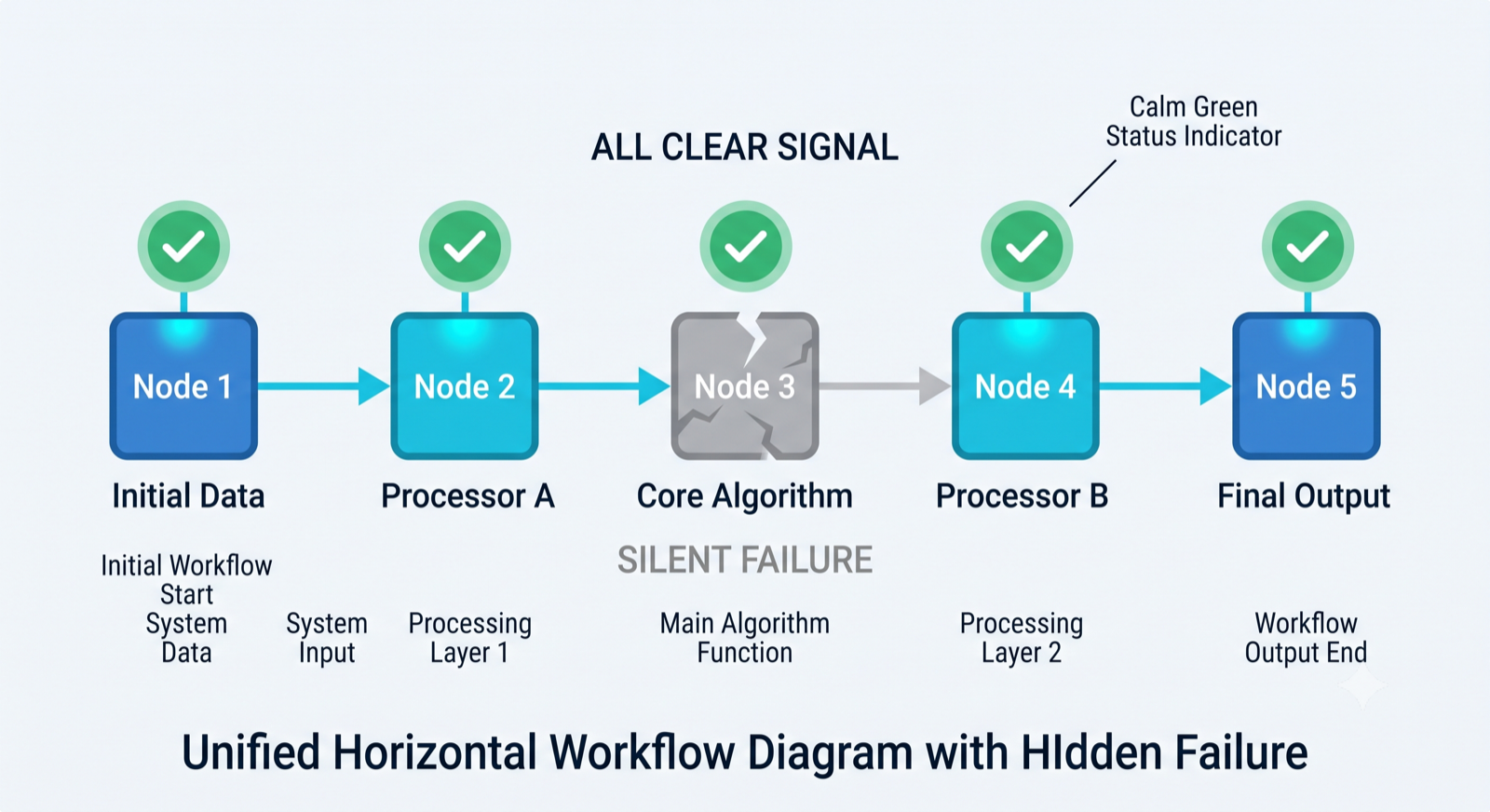
This is the quiet danger of business automation: it does not fail loudly. It fails silently, keeps the lights on, and lets you believe everything is fine until someone on the outside notices before you do. The fix is a reliability layer that no-code platforms do not give you by default, and you can build most of it inside the tools you already use.
Why automations fail quietly
No-code platforms are optimistic by design. The default assumption is that each step succeeds and the next one runs. When a step fails, the run typically stops where it stands. There is no built-in instinct to shout about it, and unless someone happens to be watching the execution history at that moment, the failure just sits there.
Multiply that across dozens of runs a day and the math is unforgiving. A failure rate you would consider tiny still means real customers falling through, one at a time, invisibly, until the pattern surfaces as complaints.
Build the reliability layer
You do not need to leave your platform to fix most of this. You need to add the parts it leaves out. There are five, and they are worth adding in order of how much pain they remove.
Alert a human on failure
Every step that touches money or communication gets an explicit failure path that sends a message to a channel a person actually reads: a Slack channel, an email inbox someone watches, a ticket. The rule is simple. If a customer would notice the failure, a human on your team should notice it first. This one change converts silent failures into loud ones, and it is the highest-value thing on this list.
Make retries safe with idempotency
The obvious response to a failed step is to retry it, but a naive retry is its own hazard. Retry a charge and you might bill someone twice. Retry a send and you might email them twice. The fix is idempotency: designing each action so that running it twice has the same effect as running it once, usually by attaching a unique key to each operation so the downstream system recognizes a repeat and ignores it. Payment systems document idempotency keys precisely because this problem is universal, and any workflow that handles money should use them.
Capture what failed so it is recoverable
When a step fails, the data it was working on should not vanish. Write the failed item, its inputs and the error, to a holding place: a dedicated table, a queue, a log. This is a dead-letter pattern, and it means a failure becomes a to-do you can retry deliberately, not a payload lost forever the moment the run stopped.
| timestamp | failed_item | error | status |
|---|---|---|---|
| 2026-08-09 14:22Z | invoice #1042 | SMTP 550: mailbox full | pending retry |
| 2026-08-09 15:01Z | webhook order #A81 | 503 from fulfilment API | pending retry |
| 2026-08-09 15:40Z | welcome_email user 913 | template render error | needs review |
| 2026-08-09 16:12Z | charge cust #557 | rate limited (429) | retried, ok |
Reconcile on a schedule
Alerts catch failures the system knows about. Reconciliation catches the ones it does not. Once a week, compare the two ends of a critical process: number of payments received against number of invoices sent, signups against welcome emails, orders against fulfilments. When the two numbers disagree, you have found a gap your alerts missed, on your terms, before a customer finds it on theirs.
Give every critical step a defined failure path
Do not let “the run stops” be your error handling. For each step that matters, decide explicitly what should happen when it fails: alert, retry safely, capture for recovery, or route to a human. Making that decision on purpose, step by step, is what separates an automation you trust from one that merely usually works.
The shift in posture
The mindset that fixes silent failure is pessimism, applied deliberately. Assume every step can fail, and decide in advance how you will know and what happens next. That is the entire difference between finding out from your own dashboard and finding out from a customer’s complaint.
None of this requires abandoning the tools you like. It requires adding the layer they leave to you. Building that reliability layer into existing automations is a defined engagement NukyLabs handles, and it usually pays for itself the first time a failure gets caught before anyone outside the company sees it.
Facing this in your own build?
NukyLabs helps founders take AI-generated apps, agents, and automations from a working demo to something that survives real users. If any of the above hit close to home, we can scope it with you.
Get a free consultation →or message us to talk through your project.