
Everyone tells the same story about outgrowing no-code automation, and it is usually about the bill. The task count crept up, the monthly price stung, and that is when people start looking for an alternative. But the bill is a distraction. The real reason to move a workflow off Zapier or Make has nothing to do with pricing, and missing that leads people to the wrong fix.
The bill is a symptom, not the disease
Yes, per-task pricing gets expensive at volume. But if the only problem were cost, the answer would be to negotiate a plan or move to a cheaper platform, and you would carry the same fragile workflow to a new home. The cost pain is real, and it is also the least important signal.
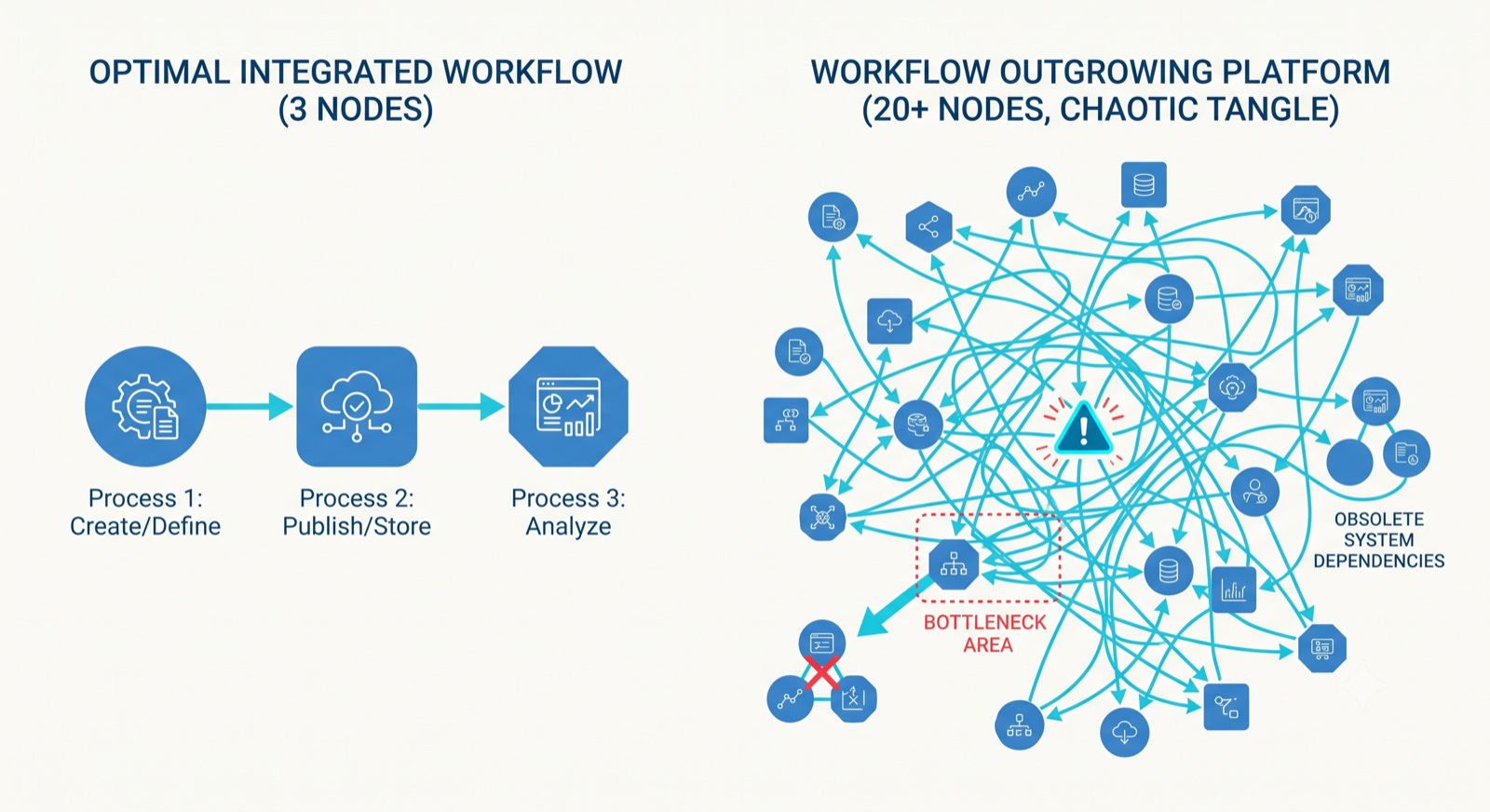
The disease is structural. A no-code scenario that has grown to dozens of steps is carrying real business logic, and the platform gives you almost none of the tools that make real logic safe to run and change.
What the platform cannot give you
Think about what you rely on when code runs your business, and notice how much of it a visual builder lacks.
No version control. When someone edits a live scenario, there is no clean history of what changed, no diff to review, and no simple way to roll back to the version that worked yesterday. The change is live the moment it is saved.
No real testing. You cannot run a change against sample data in isolation before it touches production. You edit the thing that is running, and you find out it was wrong when live data flows through it.
Weak error handling. A step fails, the run stops, and what happens next depends on whether anyone is watching. Branching recovery logic is awkward to express and easy to get wrong.
Debugging by squinting. When something misbehaves, you are scrolling through execution logs one run at a time, trying to reconstruct what happened, without the tools a developer would reach for instinctively.
The signals that you have crossed the line
You do not need to measure task counts to know a workflow has outgrown its platform. Watch for these instead.
Branching logic more than two levels deep, where conditions nest inside conditions and no one is quite sure which path a given run takes. The same scenario duplicated several times for slight variants, because there was no clean way to parameterize one. Silent failures that nobody notices for days, discovered only when a downstream number looks wrong. And any step that handles money or personal data, where a quiet failure is not an inconvenience but a liability.
Any one of these is a yellow flag. Two or more, and the workflow has become load-bearing infrastructure held together by a tool that was never meant to bear load.
The fix is not what you think
Here is where most people overcorrect. They conclude the whole thing must be rebuilt in code, they scope a big migration, and they stall because rebuilding everything is expensive and risky.
That is almost never the right move. Most of your automation works fine. The trigger, the simple routing, the connections to the tools your team already uses, all of that is exactly what no-code is good at, and ripping it out gains you nothing.
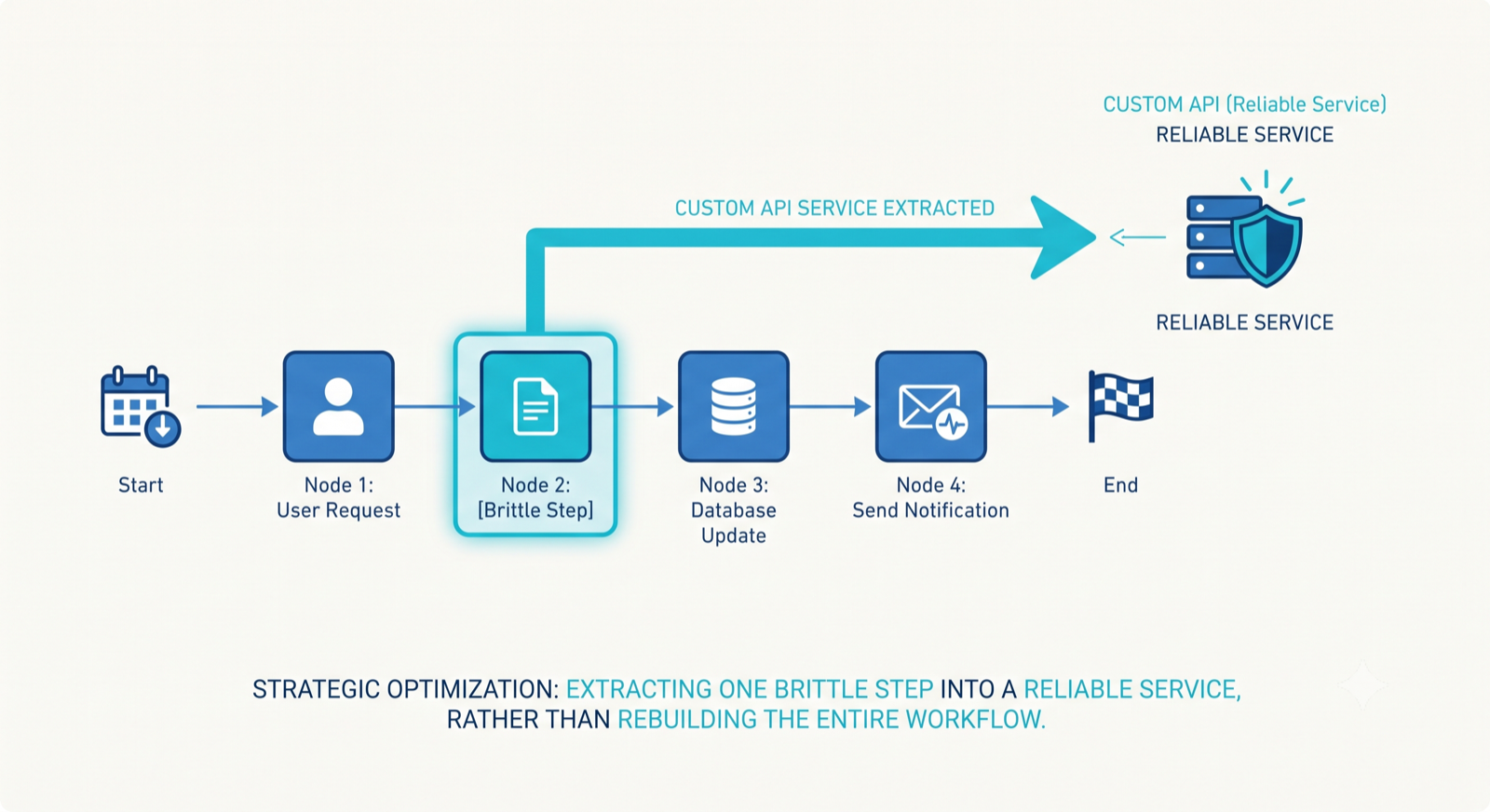
The right move is surgical. Find the two or three steps that carry the fragile, high-stakes logic, the complex validation, the money-handling, the thing that has failed silently before, and extract only those into a small custom service with a proper API. Then have your existing workflow call that service like any other step.
Why the hybrid wins
You keep everything the platform does well: the easy connections, the visual overview, the speed of change for the simple parts. You move only the logic that needed version control, testing, and real error handling into an environment that provides them. The brittle step becomes code you can test, review, and roll back. The rest stays as convenient as it always was.
This is cheaper than a rebuild, faster to ship, and lower risk, because you are changing the small dangerous part and leaving the large working part alone.
The rule to remember
Do not migrate off your automation platform because the bill grew. Extract the parts that outgrew it because they became business-critical, and keep the rest. If it has an API, it can be called from where it already lives.
Building those small reliable services and wiring them back into n8n, Zapier, or Make is a defined piece of work NukyLabs does regularly. The goal is never to throw away what works. It is to make the dangerous step safe.
Facing this in your own build?
NukyLabs helps founders take AI-generated apps, agents, and automations from a working demo to something that survives real users. If any of the above hit close to home, we can scope it with you.
Get a free consultation →or message us to talk through your project.